Style lesson #456: Earrings that dangle are good. Sentences with modifiers that do? Umm… Not so much. Considering the volume of writing we do every day, from Facebook posts, tweets, texts, emails, to, heaven forbid, old fashioned handwritten notes, do you ever stop and think about the way you write, or what your use of words might say about you?
(Unless otherwise noted, all images today are from Grammarly.)

Riddle me this, friends. If you were to compare your writing style to the fashion world, which category would you fall into?
A) The grammar skank: Your writing is the equivalent of a woman who wears her skirts too short and her heels too high. In other words, you play your punctuation fast and loose, and you’re gratuitous in your overuse of exclamation points. Occasionally, even, your errors border on the salacious.
B) The grammar sophisticate: Your words are pearls, smooth and polished, uniform and consistent. The statement they make is clear. They vex not with abrupt stops, run-on collisions or ankle-twisting gaps in thought. They are the linguistic equivalent to Carolina Herrera making a demure bow at the end of her runway show last week during Fashion Week. In other words, easy on the eyes and never out of style.
Please, humor me. Even if you’re waffling, tell me you’re choosing option B! LOL all you want, BFFs. At the end of the day, it matters what you say. And just to prove my point, here’s an example illustrating why B is the category you want to embrace:
A friend* hurriedly wrote an email to her sister about their parents’ upcoming golden wedding anniversary: “OMG!!!!!! I cant believe its mom and dads fiftieth!!!!! Im going to by them these fabulous matching shits with there names monogrammed on the pockets!!!!! They’re bowling teammates will be so jealous!!!!”
Aside from the obvious, egregious error – the missing r in shirts – which stops the reader in her tracks, how many usage errors did you spot?
*Note: All names withheld to protect the innocent.

Another example of why it’s important to pay attention to what you say and how you say it. This is almost as bad as the recurring nightmare I have of appearing naked in public. Poor woman and her great presentation gone awry!
So why this particular soapbox today? I read a compelling article recently in the Harvard Business Review that preaches to the choir for me, but bears repeating: good writing is for everyone, not just professionals. Just like your mama told you, you never get a second chance to make that first impression, and sometimes, your words are the only way people know anything about you. Here it is in a nutshell from HBR:
“Good grammar is credibility, especially on the internet. In blog posts, on Facebook statuses, in e-mails, and on company websites, your words are all you have. They are a projection of you in your physical absence. And, for better or worse, people judge you if you can’t tell the difference between their, there, and they’re.” — Kyle Wiens, “I Won’t Hire People Who Use Poor Grammar. Here’s Why.”
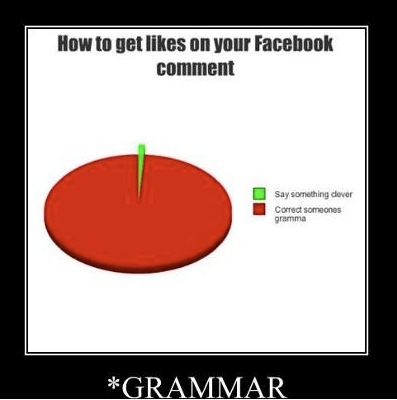
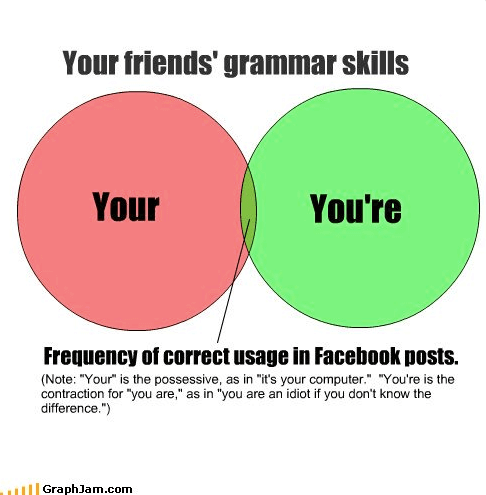
So maybe that’s why friends are quick to correct our mistakes on Facebook…they don’t want to be embarrassed to be associated with someone who doesn’t know when to use your or you’re?
But the fact remains, judgment or no, there’s LOTS of incorrect usage going on out there, folks. And my mission today is to refresh your memory on some common errors that are easy to avoid and direct you to some great resources so you can keep putting your best foot – or should I say word – forward.
One of my favorite blogs, Grammarly, dedicates pages and pages of funny cartoons to precisely this topic; and if you like them on Facebook, you’ll be treated daily to the most humorous of reminders to keep your writing in check.
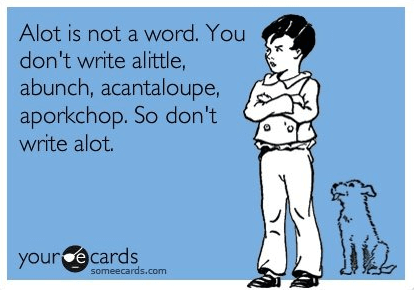
Confusing They’re, Their and There:

“There” is an adverb, which answers the question where. “They’re” is a contraction. They + are. “Their” is a pronoun. Easy peasy, right?
You’re Versus Your:

It’s Versus Its:

It’s is a contraction. It + is. Its is a possessive pronoun. (e. g. The dog and its master. Not the dog and it’s master.)
Lie Versus Lay:

People (especially politicians) lie. Objects lay.
Could’ve, Not Could Of:

Pronouns That Clash:
“Him and I went to that new restaurant for dinner Saturday night.”
“He and I went to that new restaurant for dinner Saturday night.”
Here’s Grammar Girl’s succinct explanation of this frequent flyer error: http://grammar.quickanddirtytips.com.
Missing or Misplaced Commas:
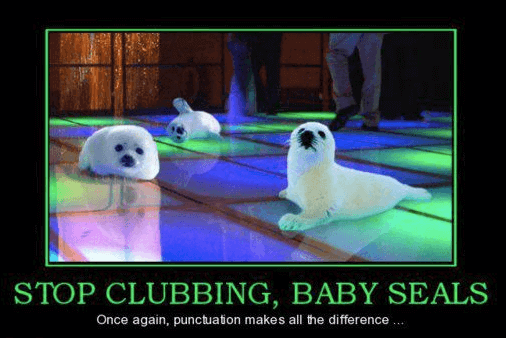

And finally, remember to proofread. It’s important to pique peak peek at whatever you write before you hit send. (SB made this goof once, and we’re still gun shy using these words!)

Commit to becoming your own best editor and practice the art of proofreading. Borrow a friend’s eyes when it’s important, or read it aloud to yourself when it’s ordinary. You’ll be glad you did.

And P.S. Don’t rely on autocorrect to keep you out of hot water.

What are your grammar pet peeves? Let us know!
36 Responses to “Psst. You’re Typeos Are Showing.”


LOVE THIS! (Pardon the liberal use of caps and exclaimer.). Twenty years ago I had a resume writing business. Once had to chase down and beg the Admin Asst. to pull the Fed Exed resume which extolled my client’s work in pubic policy. I’ve NEVER use the word “public” in writing again – spell check will not catch it.
xxoos
Kim, I choked on my coffee as I read this – too funny!! Thanks for sharing your cautionary tale! :)
My most recent grammar peeve is the growing use of “kinda” and “sorta”. Even television and radio commentators and so-called experts in their fields are sticking these “weasel words” in unnecessarily. If you’re making an emphatic point and throw “kinda” in there it doesn’t exactly make another person confident that you believe in what you’re saying. (How self-conscious am I right now writing this, by the way.) Don’t get me started on the kids using “LIKE” everywhere. ugh.
Not sure how I made my post appear here. I meant to post at the bottom. Sorry!
My grammatical pet peeve these days is the constant incorrect use of “me” and “I”. I am amazed that I even hear it in movies and tv shows.
Incorrect – John invited Ashley and I to the movies.
Incorrect – Sarah gave the nicest gift to Mary and I.
Tip – Would you say, “John invited I” or “John invited me”? When it comes at the end of a sentence, most of the time it’s “me” and it’s usually “I” at the beginning of a sentence.
I’m also so annoyed to hear people say, “Where are you at?” or “Where did you find that at?” Aaaagggghhhh!!! There is no need for the “at!”
I hear ya, Anonymous! Have you noticed the number of radio ads lately that are incorrect (Events & Adventures is a major violator)? My grandmother taught me to take the other person out of a sentence to see what pronoun to use, like you did in your example with John and Ashley. She also said that putting yourself first (“Ashley went with me and John”) was as rude as barging through a door in front of someone else.
I thoroughly enjoyed this post! As an editor, I find myself cringing daily at grammar errors not only in social media and e-mails, but also in writing that is supposed to be professional communication. It really does not make a good impression. I am a huge fan of the Grammar Girl. She has great memory tricks that make me certain about the correct grammar choice when judging some common errors such as which vs. that or ensure vs. insure vs. assure.
My pet peeve is the “word” yourall’s. As in “Are we coming to yourall’s house for dinner?” This is very common in East Tennessee and is kind of like “…coming to y’all’s house.” I found myself slip it in a time or two so now we live in Nashville.
A terrific post! Poor grammar is one of my obsessions. My daughter says that one day someone is going to slap me for correcting them. (I THINK she’s kidding!) I am amazed at the newscasters and authors who don’t know this rule and say/write “she is taller than me”. One day I’m going to email Bill O’Reilly. Even he commits this grammatical error!
Enjoyed the post, Amy!
Must be why we get along so well – similar obsessions, right?! :)
People often confuse “less,” and “fewer.” Less refers to an amount of something – She has less money than her friends; please pour less cream in my coffee, etc. Fewer refers to a number – fewer voters turn out for the primaries than for the general election; there are fewer cars on the highway on Sunday.
So, to say “less people voted” would be incorrect.
Good one! Thanks!
I always get a kick out of seeing an adult write “walla” when they mean to write “voila.”
HUGE annoying factor: Ending a sentence with the word “at”. For example: Where is John at? Where is the new Walmart at? Just plain wrong and SO incorrect, not to mention redneck sounding…
I broke up with my last boyfriend because of his tendency to end sentences with “at.” I adore the Grammar Gal blog and adore you, Amy! Great post.
Thanks, Sal!! :)
Fewer than. Less than. More than. Over. Makin’ me nuts. Even when I was a (gasp) advertising copywriter, I insisted on using those correctly. BTW — I like the clever misspelling of typeo. This post was fun!(And don’t mistake regionalism for bad grammar. Your all’s is simply a colloquialism.)
I love this SB post – the illustrations are priceless. My children get irritated when I ask them to repeat themselves when they say, “Me and Emma . . .”, “Me and Cody . . .” I’m forwarding this to all of them. We have Grammar Girl and The Only Grammar Book You’ll Ever Need sitting on the homework table. Sadly, they’ve been collecting a fair amount of dust . . .
It’s “handwritten”, not “hand-written”. Should be “that stops the reader in her tracks”, not “which stops the reader in her tracks”.
I generally keep my edits to myself, but the content of the post made it irresistible.
Rachael, professional copy editor
I stand corrected. :) Thanks, Rachel!
P.S. Rachael, here’s Grammar Girl’s explanation of which/that. In my post, using “which” is acceptable because it’s a non-restrictive clause. (I love investigating these things!) :)
“Aside from the obvious, egregious error – the missing r in shirts – which stops the reader in her tracks, how many usage errors did you spot?”
http://grammar.quickanddirtytips.com/which-versus-that.aspx
Cheers to you!
Love it! Thanks for the wonderful article!
Allow me to share #8 of our “JB CORE VALUES” (between #7, BE A GOOD LISTENER and #9, BE A LIFELONG STUDENT AND SHARE YOUR KNOWLEDGE AND IDEAS.)
8. BE RECEPTIVE OF JUDITH CORRECTING YOUR GRAMMAR
Incorrect: “Me and Zane saw the funniest thing on YouTube last night!”
Correct: “Zane and I are engaged!”
Know upfront that Judith will correct your grammar and your spelling if she notices something amiss. She’s old and can’t help this. Have pity and be mindful of the things you say and write so she doesn’t feel compelled to make these corrections! If she slips, tell her! You will get $5.00 each time YOU catch HER.
We have a lot of fun with this at work and I do have to carry around some Lincolns! -Judith
Now, correct ME if I’m wrong, but doesn’t a gerund need a possessive: “Be receptive of Judith’s correcting your grammar” ??? :)
LOVED this post – thank you, Amy!!!
Thanks, Edith! BTW, Grammar Girl says this is gray area… Usually, a gerund does need a possessive form of a pronoun, but not always. In the example you gave, you can make a case for either, actually. :) Glad you liked the post!!
Thanks, Judith! I’m glad to know you’re a grammarian as well as an amazing jewelry designer! :)
This is one of your best! And thank you for the grammar blogs. I’ll definitely check them out. Read craigslist ads if you want to be driven crazy. If you’ve never seen Designing Women, a great southern old sitcom here is a classic quote…
“I asked this Northern woman, “Where are ya’ll from?” And she said, “I’m from a place where we don’t end our sentences with prepositions.” So I said, “Okay, where are ya’ll from, bitch?”
— Charlene, designing women.
Thanks for the post!
Now that’s funny! (Am I allowed to put an exclamation point at the end of that sentence?)
This is a great post. The most annoying grammatical error or misuse of a phrase is “I could care less”. The phrase is meant to be “I couldn’t care less”. If you could care less then you are saying that you care. My mom always corrected my grammar and although she drove me crazy at the time I am so thankful that she did!
Umm. It’s spelled “typo” or its plural, “typos,” not “typeos.” (According to spellweb.com, 43% misspell it as typeo.)
Miriam– that was the point! “You’re” is also misused in the title. Just our humor that hopefully is coming across!
Very nice. Was your misuse of “hopefully” intentional also? I hope so, That is my grammar pet peeve! Love this post and the fun comments.
Here is where I stand on “hopefully is” but I’m not the author of this post! Source: Wiktionary
“The first definition (“I hope that”, used as a sentence adverb) has been criticized by some usage writers although it is by far the most commonly used sense of the word. Many adverbs are used as sentence modifiers with somewhat less frequent objection such as interestingly, frankly, clearly, luckily, and unfortunately. Unlike for many such shifts in meaning that occur in English, the portion of the American Heritage Dictionary’s Usage Panel that condones the first sense of the word has decreased from 1969 to 2000, offering the explanation that this particular usage has become a shibboleth.[2] Merriam-Webster, on the other hand, calls the usage “entirely standard”, and notes that it has been used since the early 18th century, having been commonly used in American English since the 1930s, and gained significant popularity in the 1960s.[3]
The dispute over the use of sentence adverbs is born largely of the fact that in using an existing adverb to apply to not only one verb but a whole sentence, the meaning of the word is altered, which, in certain situations, can lead to ambiguity. For example, Hopefully, he will save money for the deposit on a new house can mean either that it is hoped that he will save the money (in which hopefully is a sentence adverb modifying the entire sentence) or that he is saving money in a hopeful manner (in which hopefully modifies will save). Sentence adverbs have played a part in English since the 17C but have been limited largely to use wherein they retain their original definition (e.g. probably). It was not until the 20C that they began to be used in other situations.
“[T]here is no precise substitute,” says the American Heritage Dictionary. “Someone who says Hopefully, the treaty will be ratified makes a hopeful prediction about the fate of the treaty, whereas someone who says I hope (or We hope or It is hoped) the treaty will be ratified expresses a bald statement about what is desired. Only the latter could be continued with a clause such as but it isn’t likely.”[2] Hopefully is also less personal than I hope or we hope. It is hoped that and if hopes are realized would be impersonal and have been suggested as alternatives to hopefully,[4] but using hopefully is more concise.”
Thank you! Thank you! May I add my pet peeve to the list? Holiday cards that read “Happy Holidays from the [last name]‘s”. Please, y’all, get rid of that apostrophe!
Love this post. I couldn’t agree more with everyone weighing in. Some of the replies force the editor in me to point out that all punctuation (periods, question marks, etc.) goes inside quotation marks, not outside. It’s a common mistake. Now that I’ve read this 12 times in fear it contains a mistake, I’m posting.
As the daughter of an English teacher, I love this post!!! I would second the comment from Anon about the uses of “me” and “I” – particularly the labeling of pictures on Facebook. “a picture of Amy and I at the zoo” should be “Amy and me”….. makes me crazy.
Also – Miriam the misspelling of Typos was intentional :)
Thank you Amy for a great post!
I’m delighted to see that this wonderful post has generated lots of grammar advocates. Those who know me know my peeves already: too many exclamation points; an ampersand instead of an “and” (unless aforesaid ampersand is part of a brand name); and plain over-writing.
I’ve got a new one though. Let me phrase it as a rule: everything is not a proper noun, people. Lighten up on the caps key.